
What is Acupuncture?
Chinese Acupuncture is the 3,000 year old practise of inserting fine needles into specific points that lie along the invisible energetic pathways criss-crossing the body, through and along which Qi* – our life force energy – flows. These points, sometimes called acupressure points, ‘acupoints’ or ‘Qi-points’, are located along the 12 primary meridians, or channels: six of which either begin or end on the hands, with the other six beginning or ending on the feet.
“It is by virtue of the twelve channels that human life exists, that disease arises, that human beings can be treated and illness cured.” ~ Spiritual Pivot Ch. 17
The aim of acupuncture is to activate the body’s own innate self-healing and regenerative capabilities, removing the blockage and stagnation that impedes the optimum flow of our energies. The belief at the core of Chinese Medicine is that where balance at all levels is restored, we heal from the inside to the out: not just living, but thriving in an enduring state of good health.
Chinese acupuncture should not be confused with “dry needling” or what is sometimes called “medical acupuncture”. Dry needling involves the use of needles to attempt to release tension from knots and trigger points in muscles.
While Chinese acupuncture can be used this way, by inserting needles into what are known as ‘Ashi points’, it can also be used to treat or bring about symptomatic relief from a diverse range of ails, from acute physical injury, through to long-standing, chronic physical and emotional conditions, such as:
- Muscle & joint pain/impingement
- Tinnitus
- Bell’s Palsy
- Menopausal symptoms
- Withdrawal from addiction
- Unexplained infertility and menstrual disorders
- Weight loss,
- Oedema & bloating
- Insomnia
- Anxiety & stress
- Depression
- Constipation, diarrhoea, IBS, and other digestive disorders
- Headaches, migraine & sinus issues
- Toothache, & ear pain
- Tiredness, exhaustion, low energy, chronic fatigue, & Fibromyalgia
What can I expect?
Your first Acupuncture session with me will last around 90 minutes, and will include an initial consultation in which a detailed assessment of your general health and medical history will be taken. This will include questions about your sleeping patterns, appetite, digestion, lifestyle, diet & exercise, emotional wellbeing, as well as incorporating a review of your tongue and pulse. The depth of questioning might not seem to relate to your reason for seeking Acupuncture, but rest assured that it’s aimed at building as comprehensive a picture as possible of your health, so that I can devise your unique treatment plan for you.
Subsequent Acupuncture treatments will last around an hour, unless you choose to incorporate other elements such as Tui Na massage.
What is Tui Na?
Tui Na (pronounced “Twee-Nah”) massage has been practised for over 4,000 years and is thought to be the world’s oldest form of bodywork. It forms one of the four branches of Traditional Chinese Medicine (TCM), alongside Acupuncture, Qi Gong and Chinese Herbal Medicine, and is still practised in Chinese hospitals to this day. Tui Na was introduced to Japan around 1,000 years ago where adaptations to the original techniques used resulted in the creation of Shiatsu.
Injury, overuse, repetitive movement, poor posture, stress, sedentary lifestyle and age-related wear and tear all take their toll on our joints. Joints become stiff and painful and so range of movement is impaired. In turn, problems in the surrounding muscles, ligaments and tendons may arise if they have had to compensate for the joint’s impaired function in an attempt to stabilise and protect it from further harm.

Tui Na therapeutic Chinese massage is a suitable form of massage for most people as a safe and highly effective therapy to relieve the pain and discomfort caused by a variety of muscular, joint and nerve-related problems. It can also be used to bring relief from other acute and chronic complaints. But it is important to bear in mind that Tui Na – like Acupuncture – is a complementary therapy and so must not be considered in the same way as a standard Western medical diagnosis or treatment.
What can I expect?
Literally translated, Tui (push) Na (grasp), uses a variety of soft tissue massage techniques that differ in pressure and speed. Kneading, palpation, rolling, squeezing, rocking, plucking, vibration, and rubbing across the muscle fascia can all be used in a gentle way; similar to the techniques used in Swedish massage. Or, a more dynamic approach can be taken for a stronger deep-tissue massage.
Tui Na is intended to be invigorating and rejuvenating, but also deeply relaxing. It can be used for overall wellness and wellbeing, as well as to bring relief from the pain and discomfort caused by many common conditions affecting the physical body such as: low back, neck & shoulder pain, headache, tightness and associated pain in the jaw, and carpal tunnel syndrome.
A massage table is used, along with a chair for certain therapeutic massage techniques for the neck, shoulders and arms.
Traditionally, no oils are used in Tui Na massage (with the exception of the facial massage where a small amount of oil might be used). Rather, massage is undertaken with the recipient remaining fully clothed. Light, loose and comfortable – ideally cotton – clothing should be worn.
Joint manipulation and muscle stretching techniques are also sometimes used, similar to those used in chiropractic, osteopathy and physiotherapy. They are intended to improve the function and mobility of joints and their connective tissues.
What are the benefits of Tui Na Massage?
Here are just some of the many benefits of Tui Na Therapeutic Massage:
- Deeply relaxing and improved sense of wellbeing to relieve stress & anxiety
- Helps boost energy levels to relieve symptoms of fatigue
- Relief from the pain caused by a variety of musculo-skeletal conditions – ie Carpal Tunnel Syndrome, Tennis and Golfer’s Elbow
- Treat and alleviate muscle spasm & strain
- Relief from the symptoms of arthritis & joint pain
- Improved joint function and range of movement
- Reduces stiffness
- Reduces stress & tension and relieves pain caused by associated conditions – i.e. Tension Neck Syndrome
- Improved blood circulation, lymphatic system function, energy flow throughout the body
- Improved sleep
How does Tui Na differ from western massage therapies?
Unlike western massage therapies, Tui Na goes further than treating just the physical body. TCM is founded on the philosophy that optimum health and wellbeing – what we in the west might refer to as homeostasis – depends on harmony and balance in all things. True health is attained when equilibrium within the body, the self and the environment all coexist. Thus, the concept of health is looked at in the round and with a wide focus lens, if you will, rather than the narrower ‘zoom lens’ approach that is perhaps more characteristic of western medicine.
Tui Na, as a branch of TCM, is faithful to that overarching principle, as a means of maintaining harmony in the body. This is where the concept of Yin and Yang comes into play.
A word about Yin and Yang
We are possibly all familiar with the symbol for Yin and Yang. But what does it actually mean? It’s a way of describing the principle of duality or opposition that underpins all of creation and how we experience the Universe. How things relate to one other and how nothing can exist entirely on its own. So where we have feminine (Yin), we necessarily have masculine (Yang) as its opposite. Darkness and night (Yin) relative to light and day (Yang); cold (Yin) and hot (Yang); winter (Yin) and summer (Yang).

It is said that we are a microcosm of the macrocosm; the universe in perfect miniature form. So when we consider the twelve primary meridians, we see how there are six that are characterised as Yin, and six that are Yang. The same is said of the organs of the body. We even see how the different techniques used in Tui Na massage might be categorised in terms of Yin – gentle, soft and soothing – and Yang – active and dynamic with deep tissue stimulation. And of course, the causes of illness in TCM are distinguished in terms of how the delicate equilibrium between Yin and Yang has become compromised.
What is Qi*?
In TCM theory, ill health originates from weakness, deficiency, stagnation and blockage that interferes with the flow of our vital Life Force, or “Qi” (pronounced “chee”), eventually resulting in imbalance. In India, Qi is known as Prana. In Japan, it is Ki. The ancient Greeks called it Pneuma. The Mande peoples of West Africa knew it as Nyama, while the Mayans regarded it as Chu’lel.
Qi is the same as the chemical energy we see in western medicine and is responsible for growth, reproduction, repair and our ability to fight disease. Problems with the optimum flow of Qi can, ultimately, lead to us being affected physically, mentally, emotionally and spiritually.
With all of this in mind, the aim of Acupuncture and Tui Na is to help rid the body of these imbalances, weakness, and blockages to the flow of energy. In doing so, balance is restored. Tui Na uses the application of pressure to more than 130 specific points on the body, while Acupuncture involves the insertion of a needle into a prescribed combination of points. Optimum results are often achieved when Acupuncture is used in conjunction with Tui na (particularly for the symptomatic relief of musculo-skeletal pain), as well as electro-stimulation, cupping, moxibustion, and herbs to enhance and amplify the therapeutic effects on the recipient.
Electro-Acupuncture
The therapeutic benefits of Acupuncture can be enhanced when the acupoints are stimulated with the use of an electric current, which is delivered over the entire duration of the treatment. Similar to TENS (“Transcutaneous Nerve Stimulation”), the use of electro-acupuncture stimulates muscles, nerves as well as encouraging the movement and removal of inflammatory substances within the body that are involved in the irritation of muscle tissue. Because of that, electro-acupuncture can be a useful treatment for the relief of musculo-skeletal pain, chronic spasm, sports and overuse injuries, as well as nerve damage, delivering in some cases more rapid and longer lasting results than manual Acupuncture alone.
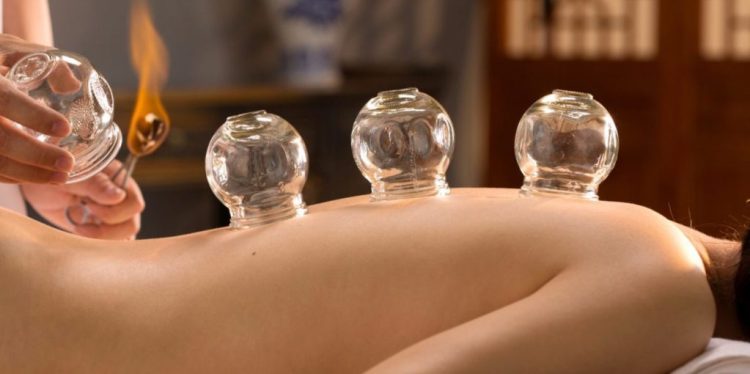
Fire Cupping
Glass cups are placed onto the skin, immediately after a heat source has been introduced, with a vacuum created as the air inside the glass cools. This draws the skin tissues upwards through suction with the aim of drawing out toxins, removing stagnation of the blood, and to encourage the improved flow of blood as well as Qi.
Moxa
Moxa, or moxibustion, is a treatment that can be used on its own or in combination with Acupuncture, to warm a specific area of the body, as well as its corresponding energetic channel. The herb, Mugwort (“Artemisia Argyi”), is useful for increasing circulation and blood flow particularly in and to the abdominal and pelvic region. The burning mugwort can be placed onto the Acupuncture needles once inserted, or a burning moxa stick can be held over acupoints to achieve the desired therapeutic effect. Moxa is commonly used in the third trimester of pregnancy to help turn a breech baby to the head-down (cephalic) position in preparation for childbirth.

Cosmetic Acupuncture & Tui Na Facial Massage
Wood Tiger Therapies offers a bespoke treatment package, intended as a natural, non-surgical alternative to the use of injectable fillers and other aesthetic treatments, which can sometimes produce an artificial looking result.
Relaxing yet stimulating facial massage techniques are used, followed by the insertion of needles at key acupoints over the body & face. Additional tiny needles are also placed into lines and wrinkles – designed to encourage the flow of Blood and Qi directly into facial tissues to: rejuvenate dull skin, reduce inflammation & acne, puffiness & dark circles, as well as improving the appearance of fine lines, wrinkles & sagging skin. The aim of a full course of treatment, delivered over 10-15 sessions – each lasting around 105 minutes – is to restore a more youthful appearance and glow from within. It is ideal for those looking to achieve a subtle, natural result where overall skin texture is improved, and the complexion is brightened. Once a course of treatment is complete, skin can be maintained with periodic top ups.
Acupuncture & Tui Na Pricing:
Initial Acupuncture Consultation including first treatment (90 mins) – £70 £75 from 1 April 2026
Follow up Acupuncture treatment (60 mins) – £50 £55 from 1 April 2026
Tui Na massage & Cupping (90 mins) – £75 £80 from 1 April 2026
Tui Na massage & Acupuncture (90 mins) – £77 £82 from 1 April 2026
Tui Na massage (60 mins) – £50 or (90 mins) – £70 – £55 or £75 from 1 April 2026
Tui Na Facial, inc. head & neck, massage (40 mins) – £40 £45 from 1 April 2026
Cosmetic Acupuncture inc Facial Massage (2 hours) – £90 £110 from 1 April 2026
SPECIAL OFFER! Wellbeing package – 1 hour 45 minutes combined Tui Na massage followed by Reiki – £80 £90 from 1 April 2026
Digital gift vouchers for all occasions also available